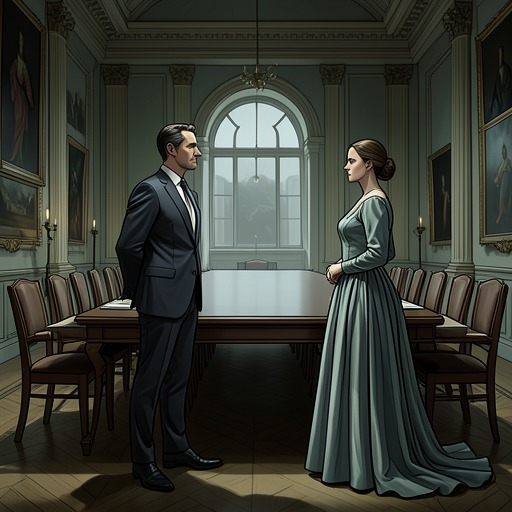
Manon Thierry–Pierre Bloui relationship
The Best Werewolf Short Stories 1800-1849The Manon Thierry–Pierre Bloui relationship is a marriage bargain born from jealousy, transformed by remorse, and completed as an act of rescue. Pierre Bloui begins as Manon’s persistent but unwanted suitor and as an instrument of the persecution directed against Francoise Thilouze; Manon finally uses his desire to marry her to make him carry a warning to Victor de Vardes. The arrangement exposes how private resentment can become public violence, but also how conscience and sacrifice can interrupt that violence at its most extreme.
Unequal Courtship and Shared Complicity
Pierre Bloui is the chief forester attached to the Montmorenci domain. He is described as an excellent huntsman but weak, ignorant, and ill-mannered, while Manon Thierry holds him in contempt and has repeatedly refused his proposals. Pierre nevertheless persists because he regards his position as making him, financially, an excellent match, and because Manon’s father, old Thierry, is his friend. His persistence is therefore supported less by mutual affection than by confidence in his social and economic usefulness.
The relationship becomes entangled with Manon’s resentment of her cousin Francoise. After Victor de Vardes is visibly captivated by Francoise, Manon recognizes a rival where she had seen none before. Pierre, who regularly visits Manon in Loques, becomes the person through whom she learns that Victor is spending his time with Francoise at Cabanis or in the surrounding woods. His report intensifies her jealousy, while his own wounded hopes make him receptive to the possibility that Francoise is responsible for Victor’s altered conduct.
Pierre then participates in the machinery of accusation. He believes that the mischief he has helped create will win the favour of his employers and gratify Manon, although he neither understands nor investigates the source of her enmity. Convinced by Jacques Renard’s confirmation of the witch story, he allows superstition, self-interest, and servility to guide him. He sets baited snares in the part of the estate frequented by Victor and Francoise, hoping to capture Francoise either as a woman or as a wolf. One trap catches a wolf’s foot rather than the animal itself, and Pierre carries the severed foot away before resetting the snare.
From Jealousy to the Marriage Bargain
When Pierre hears that Francoise has seriously injured one of her hands and that Michael Thilouze has been forced to amputate it, the trap’s evidence appears to confirm the accusation. Manon’s words have helped generate the report, while Pierre’s actions help convert rumour into a case against Francoise and her father. The lovers’ separation worsens the danger: Victor’s father has sent him to Paris, ostensibly on another errand but in reality to remove him from the neighbourhood of Cabanis.
Manon’s moral position changes when she understands the consequences of her spite. She becomes agonizingly remorseful because Michael and Francoise are about to lose their lives through idle words that originated with her. Her jealousy disappears entirely; she would now gladly prepare for Francoise’s wedding rather than witness her execution. Yet remorse alone cannot reach Victor, and the absence of rapid posts makes both sending a letter and expecting a timely reply impossible.
Pierre is therefore summoned as the only practical agent who can reach Paris. At first he fears offending the Montmorencis and refuses the risk of the journey. Manon answers by offering the one inducement capable of overcoming his fear: if he will hurry to Paris without stopping day or night and tell Victor of the danger facing her uncle and cousin, she promises to marry him on his return. The bargain is not presented as a romantic awakening. It is a deliberate sacrifice of her future, made because the lives of Michael and Francoise have become the immediate value at stake.
The offer succeeds, but Pierre’s decision is not based on the promise alone. He admits that he has privately changed his opinion of the accused. The previous night he saw the wolf beneath the chestnut trees and could have shot it, but refrained because he feared that his lord and lady would be displeased. His observation creates a contradiction he can no longer suppress: Francoise is in prison, yet the wolf still moves freely outside. When Manon points out the absurdity of identifying her cousin with the creature, Pierre recalls that he raised the same objection to Jacques Renard and was told not to interfere. The relationship thus reaches its turning point when Pierre’s obedience to authority yields to love and conscience.
The Journey and the Rescue Attempt
At sunset Pierre Bloui sets out for Paris. His departure gives the marriage bargain an immediate practical form: Manon’s promise becomes the price of a mission, while Pierre’s journey becomes an attempt to repair the harm in which he has participated. Manon waits for Victor with an imperfect understanding of the distance between Loques and Paris, expecting him after the third day. The delay becomes increasingly terrible as preparations for the witch-burning rise directly before her windows.
Pierre’s action is set against a ceremony that treats persecution as spectacle. The execution of Michael and Francoise is organized as an auto-da-fé, with scaffolding, workers, spectators, and public excitement. Manon’s remorse cannot stop the ceremony by itself; she has no authority, no letter, and no immediate access to the man whose intervention could save the prisoners. Pierre’s willingness to travel therefore represents the relationship’s first constructive act, even though the evidence does not establish whether he personally reaches Paris or how Victor obtains the king’s order.
The rescue is finally completed when Victor arrives on a foam-covered horse carrying the king’s order for arrest of execution. The production of the wolf missing a foot overturns the earlier interpretation of the foot missing the wolf. Michael and Francoise are released, and under the king’s protection Victor and Francoise marry. Pierre’s mission is consequently tied to the preservation of the couple whose love first provoked Manon’s jealousy, though the text leaves the promised marriage between Manon and Pierre unrealized.
Sacrifice and Aftermath
Manon’s contribution becomes more physically direct after Pierre’s departure. She confronts the wolf alone, survives a struggle that is never fully described, and drags the dead animal through the forest and village to the market square. She is torn and lacerated; at the place where the creature appears to have been slain, investigators find her gun, a knife, a pool of blood, and fragments of her dress. The wolf had been shot but not mortally, and other wounds evidently hastened its death.
Her arrival at the execution arena changes the crowd before Victor appears. Disheveled, blood-stained, and dragging the dead wolf, Manon can scarcely speak; she points to the animal and pleads for mercy through her appearance and gesture. The people who had gathered eagerly for the spectacle reverse themselves and cry for pardon, because her heroism has conquered their sympathies. The nobility, however, tries to preserve the execution, so Manon’s act produces a moral reversal before it produces legal safety.
Manon collapses from grief, terror, blood loss, and exhaustion, but she remains conscious of the successful result of her devotion. Before her death she receives the heartfelt forgiveness and thanks of Michael and Francoise. The old man soon follows her to the grave. Pierre’s marriage bargain therefore belongs to a larger pattern of sacrifice: he risks his employment and safety to carry the warning, while Manon spends her body and ultimately her life to provide the proof that can move the crowd and save her relatives.
The relationship ends without the conventional romantic reward promised by Manon’s bargain. The text does not record a marriage between Manon and Pierre; instead, Pierre’s role is absorbed into the chain of repentance and rescue that Manon initiates. Their relationship is significant precisely because it begins as an unequal courtship shaped by contempt and calculation, becomes a transaction under the pressure of catastrophe, and then opens into genuine ethical action. Pierre’s persistence supplies the means of travel, but Manon’s remorse supplies the purpose; together, their changed relation helps turn a story of jealousy and persecution toward rescue, forgiveness, and the survival of Francoise Thilouze.